
Guida ai Tappeti
Persian Kashan Rugs: Patterns, Materials and Buying Advice

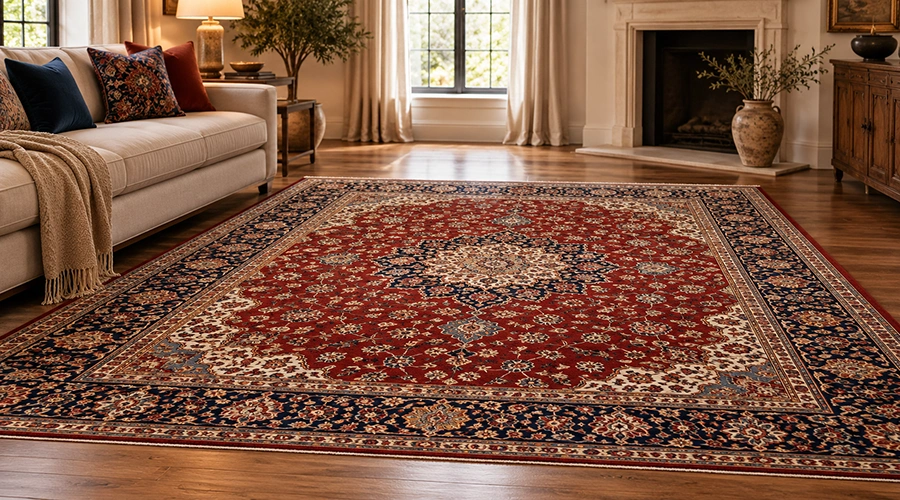
Persian Kashan rugs are known for detailed floral compositions, decorative borders and balanced central medallions. Their deep colours can bring character to both traditional and contemporary rooms. Choosing one means looking beyond the pattern to origin, construction, materials and condition.
What is a Kashan rug?
Kashan rugs take their name from the city in central Iran, in Isfahan province. The city has a long textile and silk-working tradition. Hand-knotted Kashan rugs remain admired for rich ornament and elegant compositions. Distinguish a rug made in Kashan from a rug produced elsewhere in a Kashan-inspired style.
Typical patterns and colours
Central medallions
Many examples have a large oval, diamond-shaped or intricate central medallion, with floral elements arranged towards the corners. All-over compositions without medallions also exist.
Floral ornament
Stylised flowers, leaves, palmettes and intertwining vines form curving patterns. Shah Abbasi-inspired flowers and arabesques are often part of the decorative vocabulary.
Borders
A broad main border and narrower guard borders frame the field. In finely balanced examples, their motifs relate to the central composition.
Traditional colours
Ruby red, burgundy, deep blue, ivory and cream are common, sometimes with light blue, green, beige or golden details. Red, blue and ivory are particularly recognisable, but not a universal rule.
Materials and construction
Wool on cotton: a common construction combines wool pile with cotton warp and weft. The quality and condition of wool vary, so inspect the pile and fibres.
Wool with silk details: silk highlights can add lustre and depth to selected motifs.
Silk rugs: finely detailed silk examples need careful evaluation and specialist care. Silk alone does not establish value; origin, workmanship, age and condition also matter.
How to assess authenticity
- Look at the back, where the pattern and knots of a hand-knotted rug can be examined.
- Inspect fringes: they are generally continuations of warp threads in traditional pieces, though repairs can change their appearance.
- Examine the clarity and proportions of the floral design.
- Ask about documented origin, materials, age estimates and previous restoration.
A Kashan-style design is not proof of Iranian origin. Read our guide to recognising an authentic Persian rug.
Compare quality before buying
Knot density contributes to detail but is not the only indicator of quality. Assess materials, construction and design together. Look for thin areas, repairs and damage to edges or fringes. View the surface from several directions.
Small handmade asymmetries are not automatically defects. Age alone does not make a rug better or more valuable; consider authenticity, quality, rarity and condition.
Choosing a Kashan for your home
In a traditional living room, a red medallion rug can complement wood furniture and warm colours. In a modern room, it can contrast with pale floors and simple furniture. Leave enough pattern visible to appreciate the composition.
In a bedroom, consider a medium rug beside or partly under the bed. Measure the space, doors, furniture and walking routes. Aim for balanced proportions rather than covering the whole floor.
What does a Persian Kashan rug cost?
Size, labour, wool or silk quality, knotting fineness, design complexity, origin, age, condition and rarity all affect price. A recent everyday example and a rare antique may belong to very different price ranges. See what determines a Persian rug’s price.
See Kashan rugs in Milan
At Art Tappeti, Via delle Forze Armate 43, Milan, you can examine the colours, materials and workmanship in person. Catalog examples include the antique Persian Kashan (“Kashi”) rug, 190 × 135 cm, and the extra-fine Kashan Manchester rug, 320 × 215 cm. Availability must be confirmed when purchasing.
Explore our rug collection or contact us for help choosing.
Care and maintenance
Use gentle suction and avoid aggressive brushes or pulling fringes. Rotate the rug periodically, limit prolonged direct sunlight, keep it away from damp floors and blot spills promptly without rubbing. Ask a specialist before using detergents or arranging a full wash, especially for silk and antique pieces. Our rug cleaning service assesses each rug before treatment.
Frequently asked questions
Does every Kashan rug have a medallion?
No. All-over floral compositions also exist.
Is a denser rug always better?
No. Knot density is one factor alongside materials, design, construction and condition.
Can a Kashan work in a modern interior?
Yes. Choose dimensions and colours in relation to your furniture and leave the design visible.