
Guida ai Tappeti
Crooked or Wavy Rugs: Causes and Professional Straightening

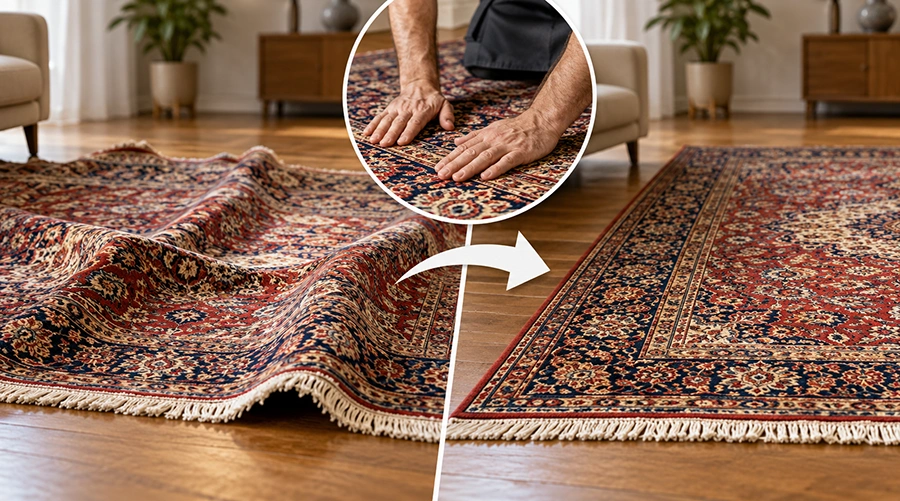
A rug with wavy edges, lifted corners or persistent ripples can affect a room’s appearance and create a trip hazard. Distortion may develop gradually or follow washing, moving or unsuitable storage. In hand-knotted Persian and oriental rugs, shape depends on the balance between warp, weft and knots.
Recognising distortion
Small asymmetries can be part of handmade construction. More concerning changes include newly wavy edges, curling corners, a noticeably skewed outline, persistent folds and raised areas. If a change is recent or worsening, identify its cause before treating it.
Why does a rug become crooked or wavy?
Humidity
Natural fibres absorb and release moisture. Uneven swelling or contraction can alter tension and produce ripples or shrinkage. Damp rooms, water contact and wet floors increase the risk.
Unsuitable washing and drying
Too much water, unsuitable products or uneven drying can change thread tension. Persian, antique and hand-knotted rugs require particular care. Our professional rug cleaning service selects treatment and drying for the material.
Warp and weft tension
Slight differences during weaving may create original irregularities. Wear, humidity and mechanical stress can accentuate them over time.
Furniture and foot traffic
Heavy furniture applies localised pressure. Dragging it across a rug can create unwanted tension and worsen an existing irregularity.
Storage, transport and past repairs
Long-term folding, tight rolling, compression and damp storage can leave persistent marks. Fragile antique rugs are particularly sensitive. Unsuitable previous repairs can also produce different tensions between sections.
What you can check at home
Check that the floor is flat and dry and that the underlay is not folded. A trapped object can make a rug appear distorted. If recently unrolled, lay the rug on a clean, dry, flat surface and observe whether light folds relax naturally. Do not pull corners or force the edges.
A breathable, non-slip underlay compatible with the floor can reduce movement, but it cannot correct permanent warp or weft distortion.
Methods to avoid
- Ironing or applying direct steam.
- Wetting rippled areas without specialist advice.
- Forcefully pulling edges or corners.
- Using very heavy weights on folds.
Heat, moisture and uncontrolled force can damage fibres, move dyes or worsen distortion. See our Persian rug care guide for routine maintenance.
When professional stretching is needed
Persistent ripples, irregular edges and a rug that no longer holds its shape may need specialist assessment. The specialist checks construction, materials, distortion direction, foundation, edges and previous repairs before choosing controlled realignment and tensioning techniques.
The structure must be stable enough. Some rugs need reinforcement first, and not every deformation can be completely removed. Preserving an antique rug’s original integrity remains a priority.
Art Tappeti offers rug stretching and straightening in Milan. If ends are damaged too, read when to repair or reweave fringes.
What does straightening cost?
Dimensions, material, construction, the extent of distortion and overall condition determine the work. Preliminary repairs may affect the quotation. Request an individual assessment instead of assuming a standard treatment will suit every rug.
Preventing new distortion
- Keep rugs away from damp floors and excessive humidity.
- Rotate periodically to spread wear.
- Lift furniture before moving it.
- Choose a compatible breathable underlay.
- Avoid prolonged folding and ask how to store fragile pieces.
- Use cleaning and drying suited to the rug.
Frequently asked questions
Will an underlay remove ripples?
It may help with movement, but does not correct permanent structural deformation.
Can I straighten a rug with steam?
Uncontrolled heat and moisture can make matters worse. Ask a specialist first.
Can every crooked rug become perfectly rectangular?
No. Original handmade asymmetry, fragile materials and previous damage can limit the result.
Send photographs and measurements to Art Tappeti for an initial evaluation.